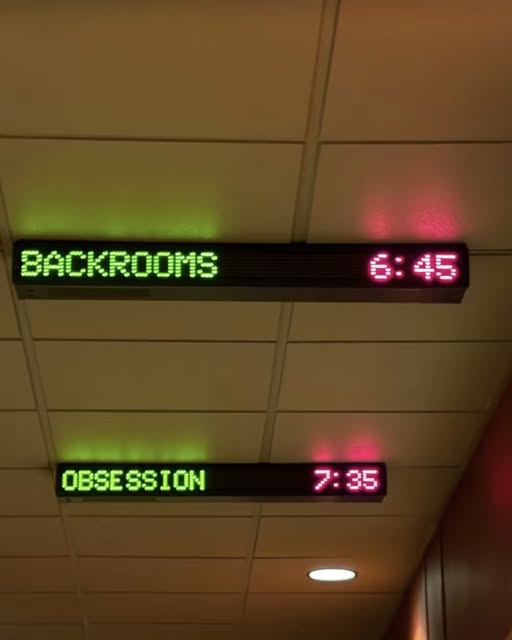
Over the course of a single weekend, I went to see two horror movies with some friends. For those of you who don’t know, I want to write horror books one day, and seeing the horror genre as a whole being taken seriously by large audiences today is probably the most exciting thing happening in my life right now.
The Backrooms

First, I saw The Backrooms.
To preface, I was very familiar with the concept of the backrooms before the movie was even a twinkle in A24’s eye. I have seen the 4chan post.

I had seen the very popular YouTube series by Kane Pixels (Kane Parsons), who is not the creator of the concept (and never claimed to be), only one whose specific version of it got extremely popular. At only 16 years old in 2022, he created the very first backrooms video in Blender.
If you are interested, here are all of his created videos in chronological order:
Upon watching these, you will get the feeling that the backrooms isn’t really a blatant horror, more of a vibe horror, if such a thing exists. The atmosphere is what drives the concept.
So upon seeing that A24 was making this movie, I was hesitant and worried about a bad cash grab. It’s not that A24 is neccisarily known for that, but a production studio could very easily toss out the vibes and turn it into an action survival horror with a million creepy entities being thrown at some lost, scared-yet-lucky-and-infallible Async scientist. But I’m so glad it wasn’t that.
So in order to get into it, let’s return to the familiar layout of my internet-friendly, millennial-beloved list. Buzzfeed has competition when I’m at the keyboard. Spoilers ahead.
The Backrooms: Direction of the Script
I like that it followed ordinary people and their experiences discovering what is essentially another dimension instead of following the company and it’s attempts at probing around in it. Not only did it make it easy to connect to them as I am also an ordinary person, it also made it easier to be terrified. Async, the company, knows there are entities in the backrooms; normal people stumbling around in there have no idea what they’ve gotten themselves into.
I also like that Kane Parsons, the director of the movie and creator of this specific lore chain of the backrooms, decided to make the movie accessible to people who didn’t see his YouTube series. You really didn’t need to know anything before going in. In fact, there were things in the movie that weren’t in the YouTube series and made the world more interesting to an outsider. I think this is a big factor in the success of this movie. Despite making it accessible and the addition of new material, it did not lose the “feel” of the backrooms, which like I mentioned before is a large part of the driving factor of the horror.
The Backrooms: The New Lore
Two things have been added:
- The still-life replicas. The non-souled, poorly copied people who are made of…uh, the stuff you can eat.
- The Captain Clark entity
There really was nothing like that before in Kane Parsons’ lore. However, their inclusion is truly what makes the movie a good study of the characters we follow.
The Backrooms: The Characters
This might be my personal bias peeking through, but it’s my review so I’m gonna let it shine. I loved Dr. Mary Kline (portrayed by Renate Reinsve). I have struggled with much of the same feelings that Mary seems to have as an adult. It was something I resonated with deeply. I saw in her a feeling of failure for not saving her mother, a feeling that compels her to become a therapist (a path I also considered for myself). I saw that feeling drive her to try to save Clark, a character who is unwilling to believe anything is wrong with him. Her attempts to save him lead to her becoming trapped in the backrooms with him, now being victimized by his lack of desire to change and leads to the realization that she cannot save anyone who doesn’t want to be saved. Then, she is trapped in a battle with Clark’s “dark side”, the entity named Captain Clark. She takes the concrete handprint from her childhood home, the place that kept her trapped all those years, the physical representation of the feelings she carries with her, and dashes it to pieces against his face, signifying her freedom from those feelings and leading to her successful escape…
…only for Async to trap her all over again. Not because she did anything wrong, they just can’t let someone who has seen that much of their secret project back into the public. Nothing personal.
Clark (portrayed by Chiwetel Ejiofor) has been facing some controversy as a character. Clark is a black man who is implied to be an abusive alcoholic to his white wife, and attacks his white female therapist. I am not black, so take everything I have to say about this with a grain of salt. I personally believe nothing would have changed had he been portrayed by any other race, and despite his flaws, he is not a totally unsympathetic character. He vocalizes a lot of interesting concepts about the obligation to change and what being trapped in a cycle can look like. He isn’t an abusive alcoholic and therapist-attacker because he’s black; he’s like that because he’s struggling with feelings of being undervalued. A lot of the way he acts out is due to his desire to be understood as he is and validated, and turning to anger when he doesn’t find what he’s looking for. It’s why he attaches himself to Captain Clark, the entity representing his repressed psyche. It’s why he finds a “home” in the backrooms, surrounded by people who aren’t ensouled and can’t be hurt by him, letting him do whatever he wants and being unable to react like real people. He’s free to consume others much the way he does in the real world, to take as much as he wants from them without them fighting back. The backrooms is a place that lets him be who he is. It doesn’t demand that he change like his wife and therapist do, it doesn’t require that he admit any wrongdoing, and thus he can give up on his self-improvement journey.
But refusing change and continuing the cycle will lead to a form of, let’s say…self-consumption.
With that said, he’s also a black character who dies, but again, I personally believe he would’ve died the same way if he was any other race, because the death is a response to the decisions he makes as a character as I have explained here. I personally believe they simply casted the best actor for the role, and the best one was Chiwetel Ejiofor. And they were right about that decision. He was great and I hope to see him in more stuff in the future.
Cycles is a major theme of this movie, and both of these characters are trapped in ones which effectively leave them in the same place they started, or result in their outright self-destruction.
I also want to add that Robert Bobroczkyi has my dream job as a creature actor. I am unfortunately very ordinary looking, but maybe I’ll end up in a horrific freak accident some day.
Obsession (2025)

I will likely write a second review in the future for this movie. After only seeing it once, I’m of the belief that it is the kind of movie that requires multiple showings to really settle in fully, especially given how complex Inde Navarrette’s acting is. Just rewatching a few of the scenes from YouTube had me picking up on things I missed in the theater. Take most of what I say in this review as somewhat underbaked.
When I first heard of this movie, it was not popular yet. I had heard of the monkey’s paw trope but had yet to see a recent horror movie really do well with it (remember “Wish Upon”?). But watching the trailer, I could just sense something was different about this one. I couldn’t even tell you what it was, but I wasn’t the only one who felt it because that very week the movie EXPLODED in popularity. And then I absolutely had to see it.
Obsession: What Makes It Better Than All The Others
Firstly, there is no room to breathe. The tension is maintained incredibly well throughout. When Freaky Nikki isn’t around, you’re searching the corners of the screen praying she won’t show up. When she is present, you’re tearing out your hair wondering what she’s going to do next. She harms herself in brutal ways, harms others in even more brutal ways, and when she’s not doing either of those things, creates an atmosphere of visceral social discomfort. All of it fills you with persistent dread. There is never a moment to relax.
Secondly, I theorize that the real driving factor behind this movie isn’t the entity that takes over Nikki’s body. It isn’t the way it acts, it isn’t the way it moves, and it isn’t even Bear being an idiot. It’s something very normal, something we’re all guilty of: lack of communication. The refusal to be sincere is what drives the plot forward. Ian deceives Bear by telling him to not tell Nikki his feelings because he is hiding that he wants to keep sleeping with Nikki. Bear follows through and deceives Nikki by not telling her his feelings. Bear deceives others by claiming “Nikki” is okay when she’s very clearly not. The only ones who are really honest about anything is Nikki and Sarah, who get dragged into things all the same. By the time anyone is honest about anything, like when Bear finally starts asking for help, nobody believes each other and the consequences cannot be undone.
Obsession: Is Bear Bad?
Nintey percent of the discourse surrounding this movie has been focused on the way Bear rips away Nikki’s autonomy by making the wish. I don’t think he’s the villain for making the wish in the first place. It’s a novelty item, who would expect it to work? Even people on the fake version of Reddit the movie shows had mixed reviews on if it works or not. Plus, she’s not really acting all that strange aside from a few blips where real Nikki is breaking through. It hardly compares to what happens later.
When Bear gets that phone call from Ian at the restaurant, telling him that Nikki didn’t actually like him and that she is also lying about her dad having cancer (as an explanation for her strange behavior), he should’ve realized immediately that the Nikki before him is not the real Nikki. It is of my opinion that right there, he puts two and two together and realizes that the One Wish Willow worked. Instead of taking a moment to process any of this, especially after her strange outburst in the restaurants, it hard cuts to them having sex. If we’re giving him credit, he may not realize yet that real Nikki’s consciousness is still in the body and is aware of what is happening, but it’s still a strange decision on his part. This is where I started becoming more critical of him as a character. It showed that he was willing to ignore a lot of red flags about her psychological state to keep his idea of a perfect relationship going.
In my opinion, he seeks help far too late. Yes, I know that there’s no way to cancel the wish, but why wasn’t he calling that number sooner? Like, maybe right after the restaurant and not when she fed him his dead cat? Why did it have to escalate that far? Even when he does call the number and discovers that real Nikki is suffering, his focus still seems mostly on containing Freaky Nikki’s behavior.
When real Nikki finally is able to communicate with Bear while Freaky Nikki sleeps, his response to her begging to die is: “What’s so bad about being with me?” I rolled my eyes in the theater. Her response, “I’ve never been with you, Bear,” is a line that’s supposed to punch you in the gut. This woman has not had any control over what’s happened to her. And then, instead of reassuring Nikki that he’s trying to find a solution, that he’s sorry for what he’s done to her, literally anything he should be saying…he walks away to meet Sarah, somehow not considering that if Freaky Nikki wakes up and finds him alone in a car at 3 AM with another woman, it likely won’t go well. And it doesn’t, as Sarah is killed.
Only after someone dies does he finally kick it into gear and start reaching out for actual help. He goes to the shopkeeper who sells the One Wish Willows, then his friend Ian trying to get him to wish that Bear never made the wish. Ian thinks he’s avoiding the truth instead of being honest about what’s really going on with Nikki and the true nature of their relationship, so he jokingly asks for a billion dollars and wastes his wish. Bear, doomed, returns to his home where Nikki waits.
As stated on the call with the One Wish Willow representative, the only thing that can free Nikki is Bear’s death, and he walks it back twice despite two of his friends being dead at this point…until Freaky Nikki finds the extra One Wish Willow and wishes that Bear would love her the same way she does, which distracts him from throwing up the pills, inadvertently saving real Nikki’s life as he dies and she snaps back into control. The final girl, who we weirdly see very little of the entire movie, and whose life is likely entirely destroyed after by actions she didn’t do and didn’t want, and who was the only person who didn’t stop fighting the intruder in her mind.
In conclusion, I do think Bear is a selfish character. A part of me suspects that if Freaky Nikki was acting normal and he became aware that real Nikki was a trapped, non-consenting consciousness, he would’ve kept things the way they were against real Nikki’s will. He dragged his feet getting help until Sarah died. His responses to the few chances he gets to talk to real Nikki and say something meaningful are wasted on his own hurt feelings. He doesn’t seem to be thinking of her very much, despite her suffering. It is kind of cathartic at the end of the movie seeing his free will become ripped away as hers has, making him unable to prevent his own death.
Obsession: How It Resonates With A Generation
As I’ve struggled more than usual to write this review, I realized I can’t quite analyze this movie without analyzing the culture to which it’s being presented. That’s been why this review is so hard, because I’m searching for stuff in the material itself instead of looking at my own feelings as a young person, and the feelings of the young people around me. So I’m going to do that now.
I feel that for young, Gen Z women, Obsession explores some of their most poignant dating anxieties. I will be first in line to say that I have found myself scared of friendzoning men or turning down their interest in me due to the potential of how they could react. Anyone who has followed my Facebook since 2020 will know that I’ve dealt with a friendzoned stalker who would trick me into believing he was different people online. Sometimes if someone feels that you’ve thwarted their power, they’ll try to take it back by force.
Also, Nikki is someone with ambitions. She wants to write. She is already working on a book. She’s trying to move forward with her life by quitting her job at the dead end music store that Bear, Sarah, and Ian also work at and going off to pursue her goals. There’s a fear as a woman of getting stuck in the same town, working the same job, with the same routine, the same friends, because of the same boyfriend keeping you there. You give up your hopeful life for a man who refuses to have ambition himself and, therefore, ruins your potential as well. Kind of like being cursed, as that is essentially what happens to Nikki when Bear makes the wish. Everything she wanted to do suddenly disappeared the moment that willow branch snapped. The same thing happens to Sarah, in a way. Because of Bear’s lack of proactiveness, she dies never even knowing that she was accepted into art school, erasing her ambitions right in front of us.
There’s a hint about the loneliness and anxieties that men feel, too. Bear is living alone in his late grandmother’s house. He seems very alone. Then, his cat dies, and it seems to really bother him. While his friends do offer their condolences, he seems hesitant to talk too much about it or reflect on how an obvious emotional support in his life has been taken out. With that in context, it is understandable that he’d feel sensitive to Nikki’s potential rejection. While it doesn’t excuse his actions later on, Bear seems to need more support than he’s getting, support someone like a girlfriend could provide.
I feel like Obsession touches on these themes. I don’t think it necessarily explores them in-depth, but I think that even at the mention of them we’re easily able to project these fears we have onto the characters and plot. That’s why it’s so loved. That’s why it’s so good. What is a good horror movie if we can’t project our fear onto it?
