I think the short length of the movie was one of the few things the creators did correctly, as if I had to actually sit through two hours of Morbius, there would be no review because I would not watch it. In the spirit of the movie, I will not waste too much of your time with this, either. I won’t even bother explaining the plot because as far as I’m concerned, you’ve had several years to watch this and realize it was bad on your own.
So, let’s break this down into an numbered list. The numbers don’t matter that much, but I know Buzzfeed made everyone love numbered lists. Hopefully there are enough millennials here that it’ll satisfy those ancient neuro-synapsys enough to balance out the frustrating material in them.
Number One: The Slow Motion Scenes
So, when a film has a slow motion scene it typically serve a purpose: to draw you in to the details. What details does Morbius want you to see? A few mid-tier bullet dodges and characters literally just running by the camera with swoopy shapes trailing around them. There is nothing interesting going on, no ornate detail the scene is drawing your focus in towards, just…Morbius being fast. Out of the many slow motion scenes I saw, I only recall thinking two were cool, and both were during the final fight between Morbius and Milo. Another slow motion scene sticks out in my mind but only because it was close enough that I could see the plastic sheen of the prosthetic vampire teeth they stuck onto Jared Leto.
Number Two: Literally the Biggest Plot Point
The whole reason why anything in this film happens is because Morbius is a sick genius. That’s not me saying he’s cool; he’s literally sick. He has a disease that requires three blood transfusions a day to survive. But since he’s also a genius, he’s trying to find a cure by studying vampire bats and eventually mixes his DNA with vampire bat DNA to cure it. On the surface, this logic makes sense if you don’t think about it too much, but unfortunately, I thought about it too much. Why would you, a person who needs an external source of blood to live, mix your DNA with a mammal that also requires an external source of blood to live and come out expecting to not need an external source of blood to live? That’s really all I have to say about that.
Number Three: Martina
Near the beginning of the movie, we hear Morbius brag about her capabilities; she’s apparently overqualified and brilliant. However, we never actually see her be overqualified and brilliant. We only see her follow Morbius’ instructions and fall in love with him. She never does anything to help him or herself that would be seen as a testament to her smarts, talent, or strength that Morbius says she has. She is totally dependent on Morbius to describe her to us and make her do things. The only ounce of personality we see from her is that she has a cat. I get the movie isn’t about Martina and I’m tired of the all-pink girl power “of course I run like a girl” trope as much as the next zoomer feminist watching Roe v. Wade crumble to dust in real time, but my complaints aren’t that she’s not outshining the men around her while in heels and on her period. My complaint is that she’s a tissue paper thin character that can’t stand up on her own without Morbius being there to give her a reason to exist. He doesn’t even have chemistry with her, she’s just the only female he interacts with on a consistent basis. Rather unfortunate when you have possibly the most gay-coded character being Morbius’ best friend. I honestly thought those two would be the ones to ride off into the sunset together after punching each other around a bit. But alas, all writers have a persistent, all-consuming urge to make the effeminate metrosexual-types the villains and the stoic masculine protagonist purely interested in his robotic boob-having companion. After I eventually get my writing degree, I expect the chip they put in your brain after handing you the diploma will force me to endure the same urges and I will be subjected to write my male characters within the context of this tired tropey dichotomy to appease the capitalism gods for the rest of my life. Pray for me.
Side note, but when the police go to her apartment, why does that guy think shaking the litter box will call the cat? Don’t you shake the cat bowl to call them? What do I know, I only live with seven cats.
Number Four: Artificial Blood vs. Real Blood
Why is this an ethical debate? It is shown multiple times in the movie that Morbius can get real blood without killing people. There are literally entire packets of it hanging in his laboratory freezer. Nobody has to die for him to rely on it, so why does he insist on only drinking artificial blood like it’s some moral high ground? If relying on real blood would cause him to grow a hunger that would result in uncontrollably killing people (as is a plot in some vampire stories), that would be understandable, but that is never shown to be the case. In fact, it seems like relying on the artificial blood is more dangerous considering it doesn’t sustain him for a consistent amount of time and is thus far more likely cause him to go into uncontrollable homicidal hunger hysterics at the wrong place and wrong time. Milo is the only person we see relying on real blood consistently, but he was a jerk with little regard for others from the start, so it’s impossible to know if he’s at the whims of an uncontrollable blood lust or just being his silly queer-coded villain self. It should be noted that the only times Morbius succumbs to bloodlust is when he first awakens with the bat DNA in him, although some level of control is still implied because he did not kill his hot research assistant, Martina, and even shows anger at the man who shoves her. However, this is the only time in the movie that consuming real blood is explicitly implied to be something out of one’s control and never at any other time, even with Milo and all the people he kills. For the most “Tell, don’t show” movie I’ve ever seen, this is a rather odd thing to never tell us.
If you want to create a hero character with a moral high ground that gives them a slight disadvantage–like Batman choosing to not kill–it needs to be explained in some fashion why that chosen moral high ground is important in the context of the story. This sort of idea isn’t one that needs to be stated, it’s sort of an intrinsic thing you pick up on after consuming enough media, so it’s rather surprising that this isn’t expounded upon in any way.
Number Five: The Train Scene
If you’ve seen the movie, you know the exact scene I’m talking about. I have to give credit where credit is due: I have not laughed that hard at a movie in years. I wasn’t sure where the surprisingly somewhat decent subway fight scene was going when Milo started running at Morbius while he stood there on the train platform, feeling the wind poetically rush by as watercolor streaks around him. I sincerely thought he was just disassociating. But when he suddenly jumps in front of the train and starts flying in front of it like a furious orange kite, it looked so insane and silly that I cry-laughed. I ironically, and somehow unironically, love it. I wish I had a recording of my initial reaction, but unfortunately it’s a moment in time I’ll never be able to get back. I’ll always think of it incredibly fondly.
Number Six: Slideshow Allegations
Simply put, the pacing and the way everything unfolded felt less like a story and more like a slideshow. I have seen true crime YouTubers put together a far better constructed storytelling aspect about someone’s real-life murder. I don’t even know how to describe what went wrong in the writing process to make it feel so dry. By the time the movie was approaching the final obligatory end-of-movie fight scene, it felt like nothing had happened even though things had been happening. It felt like a presentation about Dr. Michael Morbius instead of a story about Dr. Michael Morbius.
Number Seven: Jared Leto
I want to criticize him because I don’t like him as a person, but with the quality of the movie itself I’m not sure if I can. An actor can only do so much with what is given to him. If I see Jared Leto in a movie, he’s usually the villain, especially if that villain has a wild sociopathic streak. I’d say he’s usually okay at this if he doesn’t have to move his face around too much or do any extreme over-exaggerated gestures, which is also known as acting. I must say, this role worked for him in that regard. Morbius doesn’t really emote except with anger, and even then the anger is usually obscured with a flash of CGI bat face. I thought that was a weird choice on behalf of the writers, because wouldn’t someone who spent their entire life disabled have a lot of feelings about suddenly being able-bodied? Even if the movie didn’t want to be a commentary on disability and chronic illness, Morbius could’ve been an interesting character by even dipping a toe into the feelings a disabled or chronically ill person might have. The closest we get to said toe-dip is when it’s revealed that Morbius calls every one of his childhood friends Milo because they all end up dying, painting every boy who gets the sick bed next to him as a temporary presence that is ultimately meaningless as they succumb to the illness one after another. Isn’t that even a bit powerful? That consistently watching your friends die would make a child grow to not form serious emotional attachments? But it’s never brought up again. It never comes up in the conflicts the characters have. As a result, Morbius doesn’t feel like a complete character. Milo feels more fleshed out because he at least has a sense of humor and his villainy gives him a streak of complexity, this righteous anger towards the way he’s been mistreated as a disabled/chronically ill person.
My theory is the writers were just saving Jared Leto from actually acting, which is understandable.
Well, that’s the end of it. I know it’s low-hanging fruit to criticize a movie that’s been criticized by just about every multi-celled organism on earth, so in order to somewhat balance the wildly tipped scales I will give it one compliment:
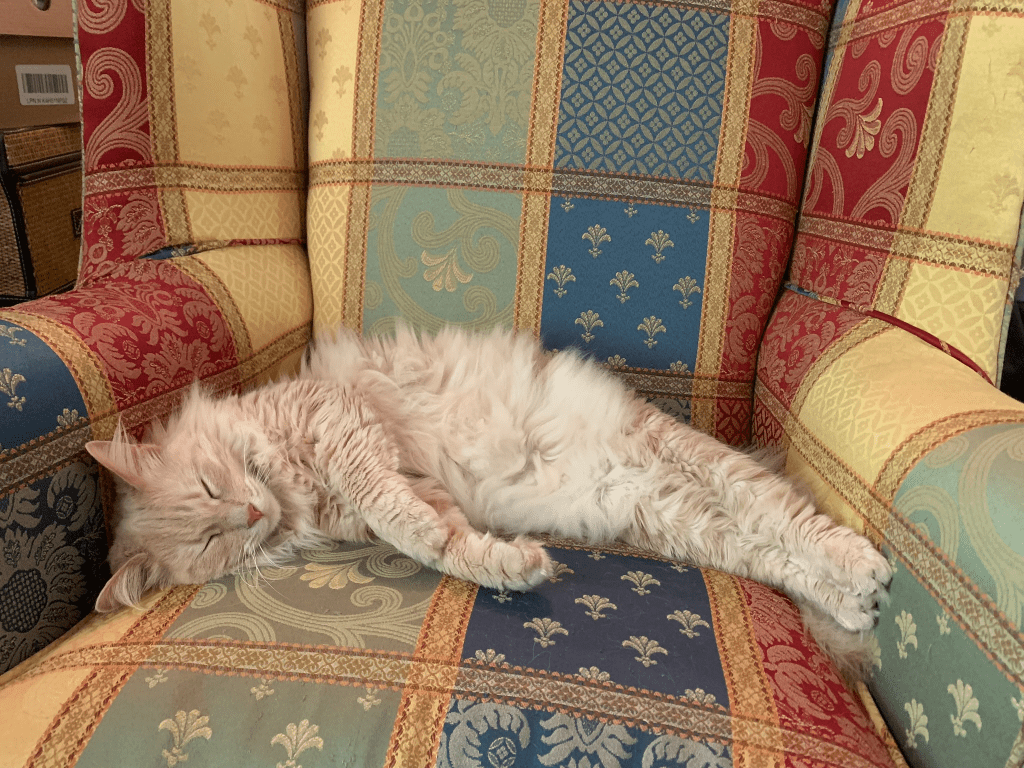
My roommate’s cat, Juno, loved Morbius. Barely took her eyes off the screen for the entire movie.
 Don't Wander Alone